
Battery or Alternator? How to Tell Which One Is Killing Your Car
Your car won't start, or something electrical is clearly wrong — and you're trying to work out whether you need a new battery, an alternator repair, or something else entirely before you call anyone. This guide works through the symptoms that point to each one, the key differences in how each fault presents, and when the answer isn't as clear as it first appears.
Start With What You Actually Experienced
The most useful diagnostic information is what happened at the moment the problem occurred. Before looking at components, work through what you noticed:
- Did the car click rapidly when you turned the key, or was there nothing at all?
- Did the car start but then die shortly after?
- Did you notice dimming lights or electrical oddities while driving before the problem started?
- Did the car start fine on a jump but then fail again when the jump leads were removed?
- Has the battery warning light come on the dashboard?
Each of these points in a specific direction.
Signs That Point to the Battery
A flat or failing battery is the most common cause of a car that won't start, and the symptoms are fairly consistent:
- Rapid clicking when you turn the key: the starter motor is getting some power but not enough to crank the engine — the classic signature of a discharged or failing battery
- Slow, laboured cranking: the engine turns over but sluggishly, indicating the battery is providing power but at reduced capacity
- Car starts with a jump and continues running: if the engine starts with jump leads and stays running after you disconnect them, the alternator is likely charging correctly and the battery is the problem
- Lights dim significantly on startup: a battery with reduced capacity shows a noticeable voltage drop when the starter motor draws current
- Battery is more than four to five years old: most car batteries have a service life of around four to five years — an older battery showing any of the above symptoms is the obvious first suspect
Visual inspection can also help. White or blue-green corrosion on the battery terminals restricts current flow and can cause symptoms that mimic a flat battery even when the battery itself has some charge remaining. Cleaning the terminals sometimes restores normal function temporarily, though it does not address an underlying battery that is failing.
Signs That Point to the Alternator
The alternator charges the battery while the engine is running. When it fails, the battery runs down even if it was fully charged to begin with — which is why alternator faults are sometimes misdiagnosed as battery problems.
- Car starts with a jump but dies again shortly after: this is the clearest alternator indicator. If the alternator is not charging, the battery depletes and the car stops, sometimes within minutes of removing the jump leads
- Battery warning light on while driving: this light monitors the charging system, not just the battery. When it illuminates while driving, the alternator output is outside the normal range
- Dimming lights or flickering electrics while driving: as the alternator fails and the battery runs down under load, electrical components begin to lose voltage — headlights dimming at idle or accessories behaving erratically are characteristic alternator symptoms
- Whining or grinding noise from under the bonnet: alternators are driven by a belt and contain bearings that wear over time. A failing alternator bearing often produces a whining or grinding noise that changes with engine speed
- Electrical or burning smell: a failing alternator can overheat the voltage regulator or associated wiring, producing a burning smell from the engine bay
Alternators generally last longer than batteries — typically 100,000 to 150,000 kilometres — but when they do fail, the consequences are more severe because the car can stop while moving.
When Neither Answer Is Obvious
Not every starting or electrical problem comes down cleanly to the battery or the alternator. Three other causes produce symptoms that overlap with both.
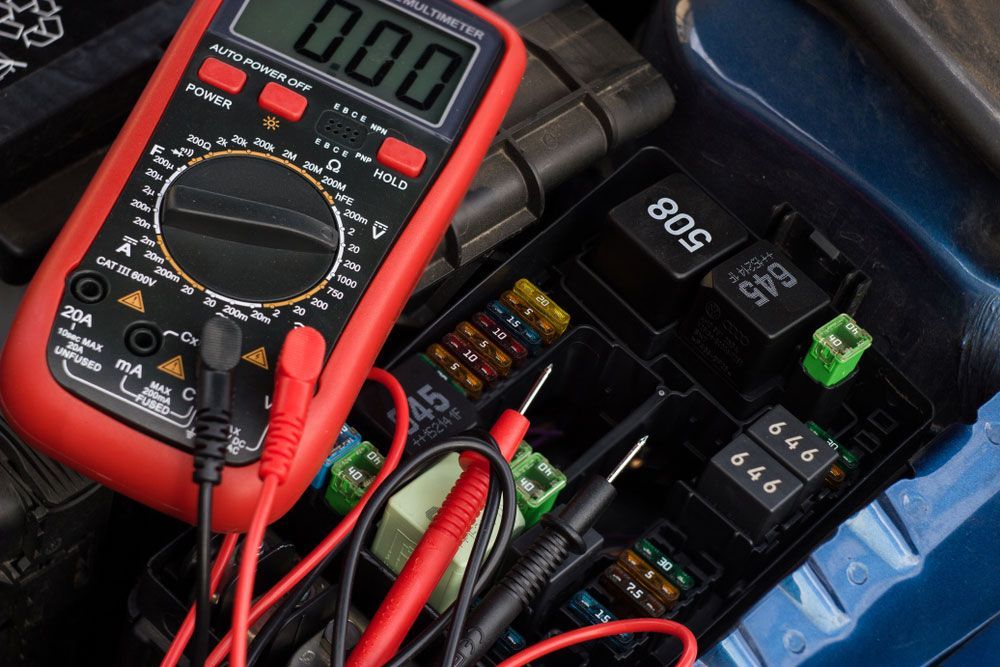
Parasitic drain is when something in the vehicle's electrical system draws current when the car is switched off — a faulty module, a stuck relay, an aftermarket accessory wired incorrectly. The battery goes flat overnight or over a few days despite being in good condition. The battery gets replaced, the problem returns. Diagnosing a parasitic drain requires a systematic test of the vehicle's circuits with the engine off, measuring current draw across each fuse in sequence.
Wiring and connection faults anywhere in the starting circuit — not just at the battery terminals — cause symptoms that look like battery or alternator failure but are actually resistance or continuity issues. A connection problem between the alternator and the battery, for example, can cause the battery to run down even when the alternator is producing normal output.
A failing starter motor produces symptoms similar to a flat battery — clicking, slow cranking, or complete failure to crank — but replacing the battery does not fix the problem. Starter faults are often intermittent, which makes them harder to diagnose without testing the starter circuit directly.
This is where professional diagnosis with the right equipment produces a definitive answer rather than a process of elimination that costs more in parts than a proper test would have.
If the Car Won't Start at All
If your car will not start and you cannot get it to a workshop, the practical problem is getting a diagnosis without being able to move the vehicle. Buckland Auto Electrical operates a mobile service across the Illawarra, Shellharbour, Kiama, Southern Highlands and Nowra — for exactly this scenario, the workshop comes to you.
A mobile auto electrician can test the battery, alternator output and starter circuit at your location, identify whether the problem is the battery, the charging system, a wiring fault or a starter issue, and in many cases complete the repair on the spot. This avoids the cost of a tow to a workshop for what is often a straightforward diagnosis.
For drivers in Wollongong and Nowra and surrounding areas, mobile auto electrical diagnosis is available when the car cannot be driven in.
Book Auto Electrical Diagnostics
Whether the problem is a flat battery, a failing alternator or something less obvious, auto electrical diagnostics at Buckland Auto Electrical identifies the actual fault rather than replacing components on a best-guess basis.
Contact us to book a diagnostic appointment or to arrange a mobile callout if the car is not driveable.